what is the fish that sticks to sharks
By Paddy Ryan
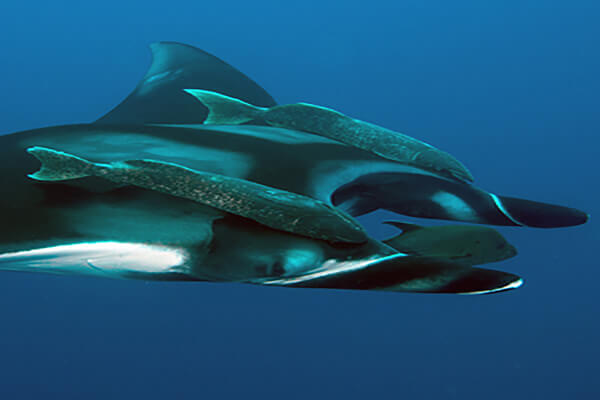
I first became aware of the beingness of remoras long before I became a diver. I call back it was in a Jacques Cousteau documentary: I have a singled-out retention of Cousteau divers removing remoras that were riding the back of a giant manta (although I have been unable to find the motion picture online). At the time, I bought into the idea that they were giant ectoparasites and carried this view with me for many years.
Subsequently I had become a diver myself, I started seeing more and more of these extraordinary fish. On a research dive in Republic of the fiji islands, I encountered dozens of them at 40m as I was examining an underwater sewage belch. A trivial disoriented and mildly narced I remember thinking to myself 'Where the heck are their sharks?'

I didn't give remoras another thought until diving in Belize several years later. Two remoras kept circling me and I noticed that somewhat ironically, ane of the remoras had some other, much smaller ane, attached to information technology. The big guys kept coming in shut equally if they were going to adhere to me. I was more than interested in photographing them than existence a host. They soon left me lone and headed towards my dive buddy, Nicole.
- Read More: Remora Hitchikers Filmed 'Surfing' Their Bluish Whale Hosts
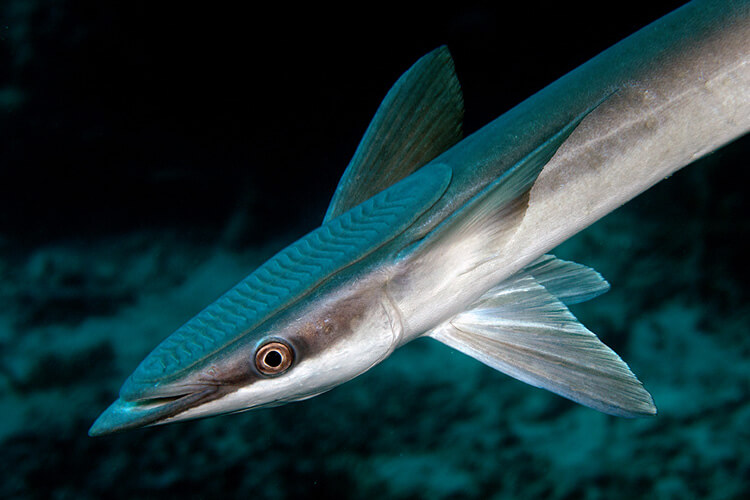
Nicole started flailing at them with easily and fins to keep them away. 'Over-reaction,' I idea to myself. When we got back to the dive gunkhole I asked Nicole why she was so excited about a pair of remoras. 'One of the bastards fleck me' was her response and she held out her wrist. A serial of scratch marks were oozing blood. This piqued my involvement equally I mentally filed abroad the data. The remoras in question wereEcheneis naucrates, besides called shark suckers.

Humans take plainly known well-nigh remoras for a long time. Remora, in Latin means filibuster, a reference to their supposed ability to slow down ships. The generic proper name Echeneis is derived from the Greek echein 'to hold' andnaus 'ship' and Linnaeus was manifestly aware of these old stories when he named the genus in 1758.
The earliest known reports of using remora for fishing appear to be from the Spaniard Peter Martyr d'Anghera who was a prominent figure at the court of King Ferdinand. He published a series of books in 1511 and in one of these he recounts, in considerable, if somewhat fanciful detail, the use of remora in the W Indies:
'The almost boggling matter is that it has at the back of its head a sort of tough pocket. As soon as the fisherman sees any fish swimming nigh the barque, he gives the signal for attack and lets go the lilliputian cord. Like a dog freed from its leash, the fish descends on its prey and turning its head throws its peel pouch over the neck of the victim, if it is a large fish.'
Boosted reports detail how large fish and animals such as manatees are also defenseless using remora.
Fisher folk in the Indian Body of water have also been using remoras to grab turtles for centuries. This was brought to Western attention as early as 1787. The Swede, Andrew Sparrman sailed to the Cape of Expert Hope. In a French translation of a book he wrote, the following quote appears (evidently translated into English language):
'They carry on a very singular method of fishing for turtles. They take alive a fish called Remora, and fixing two cords, i to its head and one to its tail, they then throw it into the depths of the ocean in the region where they judge there ought to be turtles, and when they perceive that the animal has fastened itself to a turtle, which it soon does, they draw into them the Remora and with information technology the turtle. It is said that this manner of line-fishing is also carried on in Madagascar.'
So how did the fishermen obtain their remora? They either collected them every bit a lucky accident when they caught fish with them fastened or they caught them equally juveniles in nets along with other reef fish. They were then kept in cages in the sea and fed on a regular ground.
Their sucking disc on the top of the head develops early when the youngsters are barely a centimetre in length and becomes fully functional at around 3cm. Information technology enables the remora to adhere to either rough or polish surfaces. For many years, the origin of the sucker was debated. Recently the discussion has been put to rest.
Dave Johnson, a scientist at the Smithsonian National Museum of Natural History and Ralf Britz at London's Natural History Museum studied larval remoras. These are deficient in world collections, typically only existence caught in plankton tows and ofttimes overlooked.
Johnson spent seven weeks at the National Museum of Nature and Science in Tokyo going through plankton collected between the 1950s and 1980 during a long-term report on the spawning grounds of tuna and billfish. They painstakingly digested the muscle using the enzyme trypsin, stained the young fish to reveal cartilage (blue) and bone (red) and finally stored them in glycerine. This provided a meet-through animal with all the bones revealed in exquisite detail. From development sequences, they were able to confirm what had been suggested centuries ago only never properly researched – the sucking disc is derived from the dorsal fin.
Only Dave Johnson notes that tiny remora larvae which take non yet developed a sucking disc have big hooked teeth that protrude from their lower jaw and are very rare in the plankton tows. He theorises that perchance they employ these to hang in fish gill cavities until the disc develops.
Recent research by Georgia Tech Inquiry Plant scientists Jason Nadler and Allison Mercer has given united states of america new insight into how the disc works. The disc has a series of lamellae which the fish tin can raise or lower and at that place are perpendicular rows of small spines (spinules). A fleshy ring of connective tissue around the outside of the disc provides a seal. The disc is operated by white muscle tissue and this suggests that it is a passive device. In other words, in one case a seal is made the fish does non have to expend whatsoever free energy to remain attached. Forwards motion of a host makes the seal tighter. To release, the remora swims forward. Further research may bear witness us how to produce similar devices for adhesive-free attachment – something much superior to the rubber suction loving cup.

Immature remora may be gratis-living and inhabit reefs. There is i study of a remora acting every bit a cleaner fish but they attach to hosts at a relatively small size.
In that location are currently eight recognised 'shark suckers' in three genera.Echeneis naucrates is probably the best known of these and is frequently seen on sharks and turtles.Remora remora is ane of the largest in the family and seems to favour larger hosts such as behemothic mantas. No doubt this was the remora that the Cousteau team killed in my flashback.
Remora australis, the whale sucker is found almost exclusively on whales, peculiarly blue whales, but they will besides attach to dolphins. José Martins Silva-Jr and Ivan Sazima studied whale suckers on spinner dolphins in the Fernando de Noronha Archipelago off the Brazilian coast. They observed them eating dolphin faeces and on ii occasions cleaning dolphin wounds. Pocket-size (less than ten cm) whale suckers were seen on dolphins throughout the year of report that suggests breeding may occur year-round every bit well. The authors speculated that where there were two shark suckers on the same dolphin they were likely to be a mated pair. Despite the specific name, the whale sucker is found in all of the world's oceans.
The manta suckerRemora albescens is mostly constitute on mantas and will apparently enter and peradventure reside in, a manta's rima oris or gill crenel.
Then are remoras parasites or commensals? It really depends on which species you are talking about.

The manta sucker may well exist a parasite equally its stomach contents take independent very few manta parasites and a lot of manta nutrient.
But the other species all seem to be commensals. Yep, they create a flake of drag on their host only they articulate abroad sloughing skin and scales and eat parasites. They also opportunistically feed on food scraps left past their host.

But most of the remoras take a dark secret. The bulk of their food items seem to consist of faecal matter produced by the host. It can't exist especially nutritious simply the free-ride lifestyle evinced past remoras probably doesn't expend many calories a day.
When I was at the finish of the sewer pipeline, all those remoras weren't looking for shark hosts every bit I get-go envisaged. They were in the equivalent of remora heaven just hanging around waiting for the next person to flush a toilet.
dempseyagartudded.blogspot.com
Source: https://divemagazine.com/marine-life/the-horrible-natural-history-of-remoras
0 Response to "what is the fish that sticks to sharks"
Postar um comentário